
Como Before Silk: The Wool Period
Como's textile history does not begin with silk. Contemporary scholarship places the region's first significant textile activity in the wool trade, with organized production documented from around the year 1000. The Humiliati — a religious order with a strong presence in Lombardy — played a central organizational role in the early industry, providing both labor discipline and commercial networks that moved Como cloth through northern Italian and transalpine markets.
Silk entered the picture significantly later. The transition from wool to silk as the dominant fiber began in earnest in the 16th century, with documentary sources placing its acceleration between roughly 1510 and 1554. Even then, silk remained a secondary activity for most of the 16th and 17th centuries — its industrialization came with the 18th century, when the introduction of spinning mills and organized throwing operations changed the economics of the trade.
Mulberry Cultivation and Raw Silk Supply
The physical precondition for Como's silk industry was sericulture — the cultivation of mulberry trees to feed silkworms and the subsequent processing of cocoons into raw thread. The planting of mulberry trees around the lake was systematically promoted by Ludovico Sforza, Duke of Milan, in the late 15th century, around 1400 in some accounts. The lake's geography assisted the enterprise: its shores were sheltered from the harsher alpine conditions to the north, and the lake itself provided the pure water needed for degumming and dyeing operations.
Degumming — the removal of the sericin protein that bonds raw silk filaments — required extended immersion in hot water, and the quality of that water directly affected the final fabric's hand and luster. Como's water chemistry was regarded as particularly suitable, and this geographic advantage became embedded in the industry's reputation. The combination of controlled sericulture in the surrounding countryside and high-quality water for processing gave Como a supply-chain coherence that other Italian silk centers lacked.

Loom Technology on the Como Shore
The mechanical record of Como weaving is most directly preserved at the Museo della Seta, opened in 1990 in the former Setificio Paolo Carcano building — a school founded in 1869 to train silk craftsmen. The museum holds working examples of the principal loom types used in different periods of Como's production history.
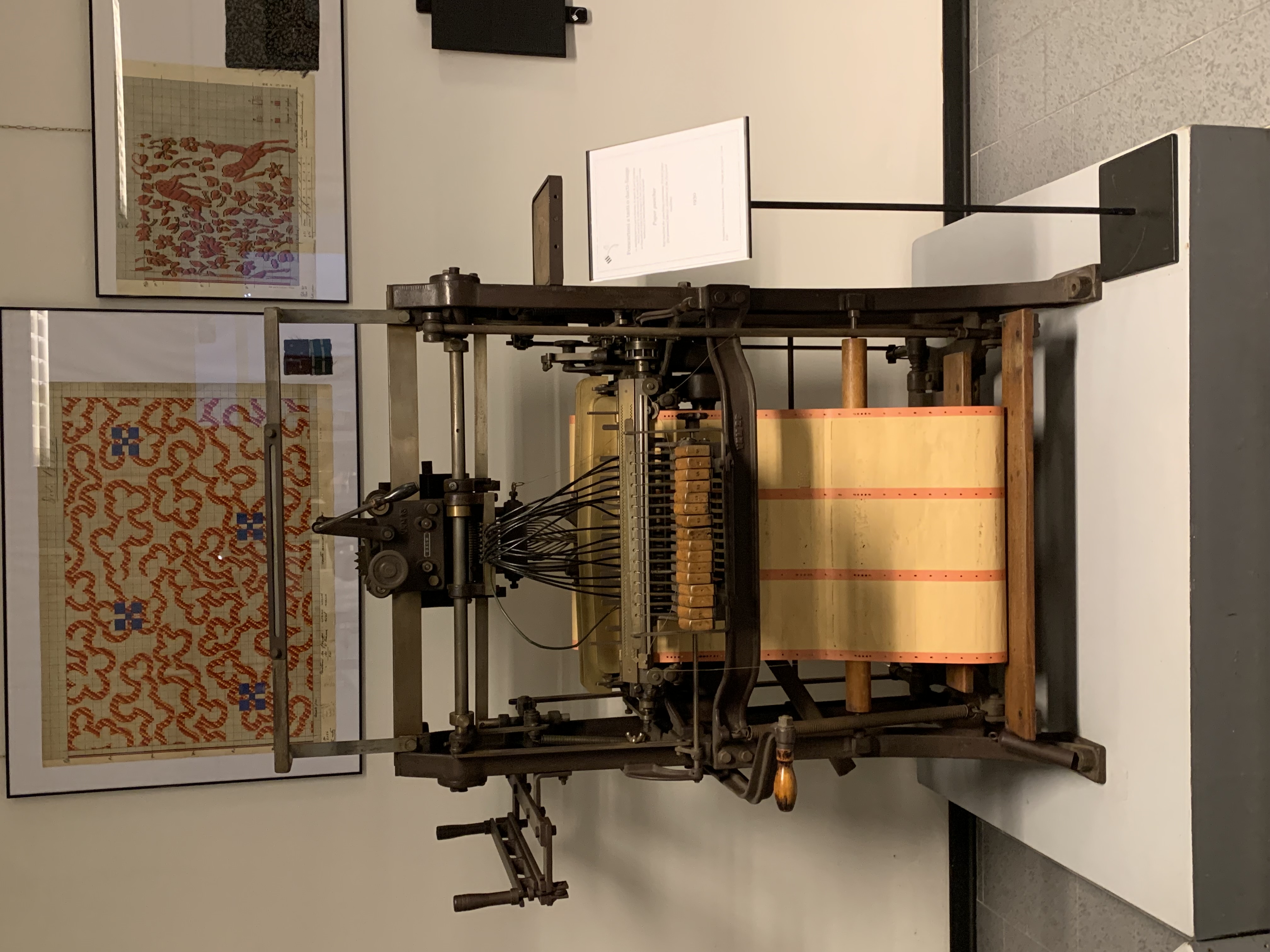
The hand-loom for Jacquard weaving is the central object in the collection. Invented by Joseph-Marie Jacquard in 1801 and adopted in Como mills by the mid-19th century, the Jacquard mechanism used a series of punched cards to control which warp threads were raised for each pick of weft. This allowed complex figured patterns — including the repeating geometric and floral designs characteristic of Como silk exports — to be reproduced mechanically without the skilled pattern-memory labor that earlier draw-looms required.
Also preserved is a doppia ratiera, a loom attachment that uses wooden pegs rather than punched cards to read designs. The doppia ratiera was used for simpler repeating patterns — a less capital-intensive alternative to the Jacquard for smaller production runs. The museum's 1922 mechanical loom from OMITA represents the transition to fully motorized production that characterized Como's output in the first half of the 20th century.
Blended Fibers: Silk and Linen in Production
Pure silk cloth dominated the prestige end of Como's market, but blended fabrics — combining silk warp with linen, cotton, or wool weft — occupied a substantial share of production across different periods. The documentary record from the wartime archives of Como weavers, analyzed in scholarship by Margherita Rosina and held in the collections of the Fondazione Antonio Ratti, shows that mixed-fiber production was not a marginal activity but a deliberate response to fiber availability and price conditions.
Linen weft combined with silk warp produced a fabric with different drape and weight properties than all-silk cloth. The linen gave the fabric a crisper hand and slightly increased durability, while the silk warp maintained the surface luster that defined Como's commercial identity. These blended fabrics were sometimes positioned explicitly as practical alternatives — lighter in cost, suitable for different end uses — rather than as inferior substitutes for pure silk.
The wartime period documented in the Ratti archives is particularly instructive. Restrictions on raw materials during World War I required Como manufacturers to substitute available fibers for those in short supply. The records from major manufacturers — including Bressi (250 handlooms and 25 Jacquards) and Casnati (360 Jacquard looms) — show the adaptation of existing loom setups to accommodate different weft fibers without full reconfigurations of threading or pattern cards.
The Setificio and Craft Training
The founding of the Setificio Paolo Carcano in 1869 represented an institutional investment in maintaining Como's technical capacity alongside its industrial expansion. The school trained workers in weaving, design, and pattern-making, and its graduates moved into both mill employment and independent production. By the late 19th century, Como's production had exceeded that of many competing regions; a frequently cited figure places its output by 1972 above that of China and Japan in certain categories of finished silk fabric.
The school's building later became the Silk Museum, which maintains the Setificio's mission of documenting and transmitting the technical knowledge associated with Como weaving. Researchers with specific interests in loom mechanics, Jacquard pattern archives, or the history of blended production can contact the museum directly for archival access.
Contemporary Production and Fashion Industry Ties
Como's current silk and textile production operates in a fundamentally different market from the mass-production period of the mid-20th century. The district now supplies fabric to a limited number of high-end fashion houses, with documented relationships including Chanel, Dior, Gucci, and Armani. Production volumes are lower; the emphasis has shifted toward material quality, low run-sizes for specific collections, and the technical complexity of pattern execution that remains difficult to automate.
The mixed-fiber tradition has a smaller role in this current market, which tends to favor pure silk or technically advanced synthetic blends over the linen-warp combinations of earlier production. However, the historical record of blended production preserved in mill archives and the Ratti Foundation's textile collection remains accessible to historians of material culture and industrial history.
External reference: Museo della Seta Como — official archive and exhibition information.

